Why do metal parts shine like mirrors? The answer often involves a polishing machine.A polishing machine smooths rough surfaces. It removes tiny scratches and defects.In this article, you will learn how a polishing machine works. We will explore its principle and key components. You will also see how the polishing process happens.
The Working Principle of a Polishing Machine
How friction and abrasive polishing remove surface imperfections
A polishing machine operates by generating controlled friction between abrasive materials and the surface of a workpiece. When the machine runs, the polishing pad or media moves against the material while carrying fine abrasive particles. These particles act like microscopic cutting edges that gradually shave off the highest points on the surface. Over time, this controlled abrasion evens out irregularities such as scratches, oxidation marks, burrs, and machining lines, producing a smoother and more reflective finish.
Unlike aggressive machining processes, polishing relies on precision and consistency rather than force. The process is designed to reduce surface roughness without damaging the underlying material. The interaction between the polishing pad, abrasives, and the workpiece must be carefully balanced to ensure uniform results across the entire surface.
Key characteristics of friction-based polishing include:
● Microscopic material removal: Abrasive particles remove extremely small peaks on the surface.
● Uniform surface leveling: Continuous contact ensures that imperfections are gradually blended into the surrounding area.
● Controlled pressure and motion: The machine’s speed and applied pressure determine how quickly and effectively the polishing occurs.
Factor | Function in the Polishing Process |
Friction | Generates the mechanical action needed to smooth the surface |
Abrasive particles | Perform micro-cutting to remove surface irregularities |
Polishing pad or media | Distributes abrasives evenly across the surface |
Machine motion | Ensures consistent contact between abrasives and the workpiece |
Through this combination of friction, abrasives, and controlled movement, polishing machines are able to transform rough or dull surfaces into smooth, visually appealing finishes.
Why polishing removes only a microscopic layer of material
One of the defining features of polishing is the minimal amount of material removed during the process. Unlike grinding or cutting operations that may remove large volumes of material, polishing typically removes only a thin layer measured in microns. This small-scale material removal is essential because the goal of polishing is not to reshape the part but to improve the quality of its surface.
The polishing process works by gradually removing the microscopic “peaks” on a rough surface while leaving the deeper structure intact. As the peaks are eliminated, the surface becomes flatter and more reflective. Because the amount of removed material is so small, the original dimensions and geometry of the component remain unchanged.
This characteristic makes polishing particularly valuable in industries where dimensional accuracy and surface quality are both critical, such as precision engineering, electronics manufacturing, and aerospace components.
Important advantages of microscopic material removal include:
● Preservation of the original geometry of the workpiece
● Reduced risk of structural damage
● Ability to produce extremely smooth finishes
● Improved corrosion resistance and aesthetic quality
In many applications, polishing is performed as the final stage of surface finishing, after machining, grinding, or lapping processes have already established the basic shape of the part.
The role of polishing compounds and abrasives
Polishing compounds play a central role in determining the final surface quality achieved by a polishing machine. These compounds contain fine abrasive particles that are suspended in a liquid, paste, or slurry. During operation, the compounds spread evenly across the polishing pad or media and create a thin abrasive layer that interacts with the workpiece surface.
Different abrasives are selected depending on the material being polished and the desired surface finish. Harder abrasives are typically used for metals and durable materials, while softer abrasives are chosen for delicate surfaces such as plastics or coated components.
Common polishing abrasives include:
● Aluminum oxide: widely used for metal polishing due to its durability and balanced cutting ability.
● Silicon carbide: ideal for aggressive polishing tasks and harder materials.
● Diamond abrasives: used in high-precision polishing where extremely fine finishes are required.
Abrasive Type | Typical Application | Surface Finish Quality |
Aluminum oxide | General metal polishing | Smooth, uniform finish |
Silicon carbide | Hard materials and heavy defect removal | Moderate to fine finish |
Diamond abrasive | Precision polishing and advanced materials | Ultra-fine mirror finish |
In addition to abrasives, polishing compounds often contain lubricants and chemical additives. These components reduce friction heat, improve abrasive distribution, and help maintain consistent polishing performance throughout the process. The correct combination of abrasive type, particle size, and compound formulation is essential for achieving optimal polishing results.
Example of an Automated Vibratory Polishing Machine
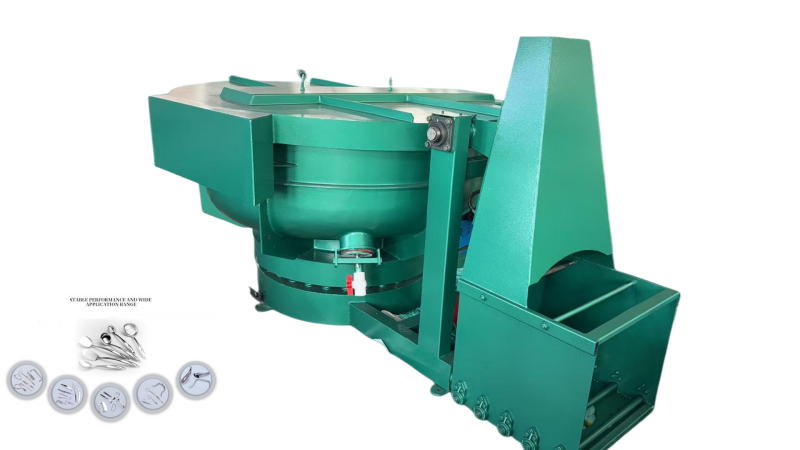
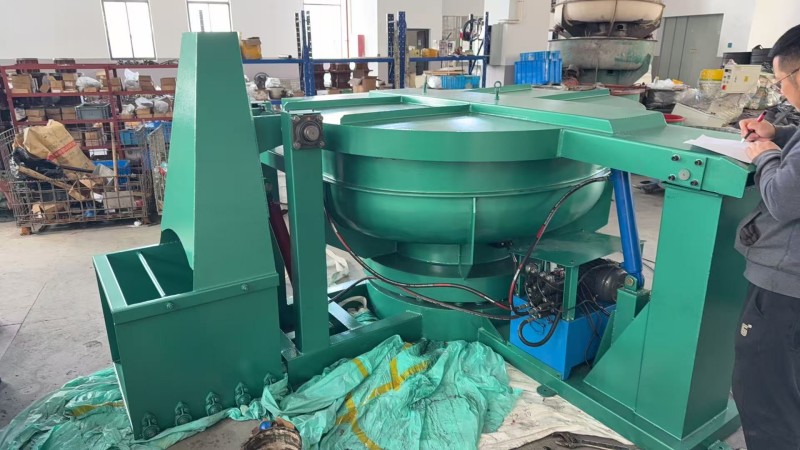
In modern manufacturing environments, polishing machines are increasingly equipped with automation and intelligent control systems to improve efficiency and ensure consistent finishing quality. A representative example is the ABS(F) series Auto-Feed Vibratory Polishing Machine developed by Huzhou Antron Machinery Co., Ltd. This machine is designed specifically for hardware deburring and edge rounding, combining automated feeding technology with vibratory polishing to reduce manual handling and improve production stability.
The machine operates using a tri-dimensional eccentric drive system that generates controlled vibration inside the polishing bowl. Under this vibration, workpieces and abrasive media move in a spiral tumbling flow pattern. Continuous friction between the parts and the polishing media gradually removes burrs, rounds sharp edges, and improves surface smoothness while maintaining the dimensional accuracy of the components.

Key Technical Features
The ABS(F) series incorporates several design features that improve reliability and polishing efficiency in industrial environments:
● Intelligent loading hopper: Equipped with an automatic weighing function that quickly measures the batch weight of workpieces to prevent equipment overload.
● Servo-controlled feeding gate: Releases workpieces into the vibratory bowl according to preset processing cycles, ensuring accurate batch feeding.
● Tri-dimensional eccentric vibration drive: Produces vertical, horizontal, and circumferential motion, allowing workpieces and polishing media to interact evenly for uniform surface finishing.
● Hydraulic bowl tilting system: Enables the vibratory bowl to tilt up to 120°, allowing finished parts and grinding media to be discharged efficiently.
● Automatic separation screen: Quickly separates polished workpieces from grinding media to maintain continuous operation.
Key Performance Parameters
Parameter | Specification | Description |
Gate response speed | 0.1 seconds | Enables fast and precise batch feeding |
Batch weight deviation | ±50 g | Ensures accurate loading control |
Recipe storage | 64 processing programs | Allows quick switching between different workpiece types |
Hopper liner thickness | 4 mm PU liner | Provides durability with up to 30,000 hours service life |
Equipment efficiency (OEE) | ≥95% | Maintains stable long-term production performance |
Typical Application Materials
The machine is suitable for polishing and deburring a wide variety of materials and components commonly used in manufacturing industries:
● Zinc alloy accessories such as buttons, badges, and zipper pulls
● Brass valve components requiring smooth sealing surfaces
● Aluminum-magnesium alloy frames used in electronics
● Stainless steel screws and precision fasteners
● Injection-molded plastic components made from ABS or PC
By integrating automated feeding, precision vibration technology, and durable structural design, the ABS(F) series vibratory polishing machine provides a stable solution for high-volume surface finishing applications in hardware manufacturing and precision component processing.
Key Components Inside a Polishing Machine
Motor and Drive System
The motor and drive system provide the mechanical power that enables a polishing machine to operate. The motor converts electrical energy into motion, allowing polishing pads, discs, or vibratory bowls to move at controlled speeds. Depending on the machine design, this motion may be rotational, oscillating, or vibratory.
Industrial machines often include gears, belts, or eccentric mechanisms to transfer power from the motor to the polishing unit. These components help maintain smooth and stable movement, which is essential for achieving consistent polishing results.
Main functions of the motor and drive system:
● Generate the motion required for polishing
● Maintain stable rotation or vibration during operation
● Support consistent performance under different loads
Component | Function | Role in Polishing |
Electric motor | Converts electrical energy into motion | Powers the polishing process |
Transmission system | Transfers motion to polishing head | Ensures stable operation |
Eccentric mechanism | Produces rotation or vibration | Determines polishing movement |
Polishing Pads and Backing Plates
Polishing pads are the parts that directly contact the workpiece surface. They hold abrasive compounds and distribute polishing pressure evenly, allowing imperfections to be gradually removed. Pads are usually attached to a backing plate, which connects them to the machine spindle and ensures stable movement.
Common polishing pad materials include:
● Foam pads: Suitable for finishing and refining surfaces with balanced softness.
● Wool pads: More aggressive and effective for removing scratches or oxidation.
● Microfiber pads: Offer a balance between cutting ability and smooth finishing.
In many polishing processes, operators use multiple pads in sequence—starting with more aggressive pads and finishing with softer ones to achieve a smoother surface.
Abrasive Compounds and Polishing Media
The actual polishing action is performed by abrasive compounds or polishing media. These materials contain microscopic particles that gradually remove surface irregularities during machine operation.
Polishing compounds may appear as liquids, pastes, or slurries and are applied to polishing pads or directly into polishing media systems. As the machine moves, these abrasive particles act like micro-cutting tools that smooth the workpiece surface.
Abrasive Material | Typical Use | Finish Quality |
Aluminum oxide | General metal polishing | Smooth and uniform |
Silicon carbide | Hard materials | Faster defect removal |
Diamond abrasives | Precision polishing | Mirror-like finish |
In vibratory polishing systems, ceramic or plastic media may replace pads. These media tumble with the parts and create continuous friction that removes burrs and smooths surfaces.
Speed Control and Process Stability
Modern polishing machines often include adjustable speed control and process regulation systems. These features allow operators to optimize polishing conditions for different materials and surface requirements.
For example, softer materials such as aluminum or plastics usually require lower speeds to prevent overheating. Harder metals may require higher speeds and stronger polishing action.
Key process control features include:
● Variable speed settings for different materials
● Stable rotational or vibratory motion for uniform polishing
● Programmable cycles that maintain consistent polishing time
By maintaining stable speed, pressure, and abrasive contact, polishing machines can produce consistent surface finishes while improving overall production efficiency.
How the Polishing Process Works Step by Step
Surface Preparation Before Polishing
The polishing process begins long before the machine is turned on. Proper surface preparation is essential because contaminants such as dust, oil, rust particles, or machining residues can interfere with the polishing process and even create new scratches on the surface. If these impurities remain on the workpiece, abrasive particles may trap them between the pad and the material, resulting in uneven polishing or surface damage.
For this reason, workpieces are typically cleaned using solvents, detergents, or specialized degreasing solutions before polishing begins. In industrial environments, ultrasonic cleaning systems or chemical washing processes are often used to ensure that surfaces are completely free of contaminants. Once cleaned, the surface is dried and inspected to confirm that it is ready for polishing.
Effective preparation also involves checking the initial surface condition of the material. If the surface contains deep scratches or machining marks, preliminary processes such as grinding or lapping may be required before polishing can achieve a high-quality finish.

Typical preparation steps include:
● Surface cleaning: Removing grease, dust, and residual particles ensures abrasives interact only with the workpiece surface rather than unwanted debris.
● Initial inspection: Operators examine the surface to determine the severity of imperfections and select the appropriate polishing method.
● Selection of polishing materials: Choosing the correct pad and abrasive compound at this stage ensures the polishing process proceeds efficiently and safely.
Preparation Step | Purpose | Impact on Polishing Quality |
Cleaning and degreasing | Removes contaminants from the surface | Prevents scratches during polishing |
Surface inspection | Identifies defects and imperfections | Helps determine the correct polishing method |
Material and abrasive selection | Matches abrasives with surface condition | Ensures efficient and controlled polishing |
By carefully preparing the workpiece, operators create optimal conditions for the polishing machine to deliver consistent and predictable results.
Controlled Contact Between the Polishing Pad and the Workpiece
Once the surface is properly prepared, the polishing machine begins its primary operation. During this stage, the polishing pad—often coated with abrasive compound—moves against the workpiece surface through rotation, oscillation, or vibration depending on the machine design. The interaction between the pad and the surface generates controlled friction, which gradually removes microscopic imperfections.
The effectiveness of this stage depends on maintaining a balanced combination of motion, pressure, and speed. Excessive pressure can damage the surface or cause overheating, while insufficient pressure may result in ineffective polishing. Modern polishing machines are designed to maintain stable operating conditions, allowing abrasive particles to evenly distribute across the polishing area.
Several factors influence the polishing contact process:
● Machine motion: Rotational or vibratory movement ensures that abrasive particles continuously interact with the workpiece surface. This motion prevents localized wear and promotes uniform polishing.
● Pressure control: Controlled pressure allows abrasives to remove microscopic peaks without deforming the material or generating excessive heat.
● Lubrication from polishing compounds: Compounds reduce friction heat and help distribute abrasives evenly across the surface.
These elements work together to create a stable polishing environment in which surface irregularities are gradually leveled out. Over time, the repeated interaction between abrasives and the material produces a progressively smoother surface.
Multi-Stage Polishing for Improved Surface Finish
High-quality polishing rarely occurs in a single step. Instead, the process is typically performed in multiple stages, each designed to progressively refine the surface finish. The first stage focuses on removing visible defects such as scratches, oxidation marks, or machining lines. Subsequent stages gradually refine the surface until the desired level of smoothness or reflectivity is achieved.
Each stage uses abrasives with different particle sizes. Coarser abrasives remove larger imperfections quickly, while finer abrasives polish the surface at a microscopic level to produce a smooth, reflective appearance. The transition between stages must be carefully controlled so that each step removes the marks left by the previous stage.
A typical polishing sequence may include the following steps:
1. Initial defect removal stage Coarse abrasives remove surface irregularities such as scratches or burrs left from machining processes. This stage prepares the surface for finer polishing.
2. Intermediate polishing stage Medium abrasives refine the surface by reducing roughness and smoothing out the marks created during the previous stage. At this point, the surface begins to appear more uniform.
3. Final finishing stage Fine abrasives or polishing compounds are applied to achieve a high-quality finish. This stage enhances surface brightness and may produce a mirror-like appearance depending on the material.
Polishing Stage | Abrasive Size | Primary Objective |
Coarse polishing | Large abrasive particles | Remove scratches and surface defects |
Intermediate polishing | Medium abrasives | Reduce surface roughness |
Final polishing | Fine abrasives | Achieve smooth or reflective finish |
By progressing through these stages, polishing machines can transform rough or dull surfaces into highly refined finishes suitable for precision engineering, decorative applications, or high-performance industrial components. This systematic approach ensures that the polishing process is both efficient and capable of producing consistent, high-quality results across a wide range of materials.
Conclusion
A polishing machine smooths surfaces with motion and abrasives. It removes tiny defects and improves surface quality. Understanding its parts and process helps achieve stable results. It also improves efficiency in industrial finishing. Huzhou Antron Machinery Co., Ltd. provides advanced polishing solutions. Its automated vibratory machines improve precision and productivity.
FAQ
Q: How does a polishing machine work?
A: A polishing machine uses rotating pads or vibratory motion with abrasives to remove microscopic surface defects and create a smoother finish.
Q: What materials can a polishing machine process?
A: A polishing machine can process metals, plastics, ceramics, and composites, depending on the abrasive media and polishing parameters used.
Q: What is the difference between grinding and a polishing machine?
A: A polishing machine removes only microscopic material layers, while grinding removes larger amounts to shape or dimension a workpiece.
Q: What factors affect polishing machine performance?
A: Polishing machine performance depends on abrasive type, pad material, speed settings, and consistent pressure during the polishing process.